
Morton County Court Records After Arrest
The Morton County arrest-to-court path runs from law-enforcement custody to prosecutor review to district court filing. A booking may happen at the Morton County Law Enforcement Center / Morton County Jail, but the court record begins when charges are filed for prosecution. The Morton County Attorney, David Thompson, is the county attorney listed by Morton County, and the office handles criminal and civil actions for or against the county.
Formal case records are handled through Morton County District Court, part of the Kansas 26th Judicial District. For booking status, custody, or jail release questions, use the sheriff's office and the jail inmate records path. For booking photos, use the separate jail mugshots topic because Kansas treats mugshots differently from basic court docket information.
Find Court Records After Jail Arrest
Kansas provides statewide public district court searching through Kansas CaseSearch, and the Kansas courts also publish district court records access information. CaseSearch is useful once the court case exists. If an arrest is very recent, first confirm custody with the Morton County Sheriff's Office. Then check CaseSearch by party name or case number. If the online record is incomplete, contact the court clerk.
- Confirm the person was booked or released through the Morton County Sheriff's Office / Law Enforcement Center.
- Allow time for prosecutor review because a new arrest may not create an immediate court case.
- Search Kansas CaseSearch by defendant name, case number, business name, or citation when those details fit the case.
- Open the case and review each listed charge, hearing, disposition, and bond entry.
- Contact Morton County District Court for older files, unavailable documents, public terminal access, or copy procedures.
The Kansas CaseSearch screen at Kansas CaseSearch is the statewide starting point for public court records after a jail arrest.
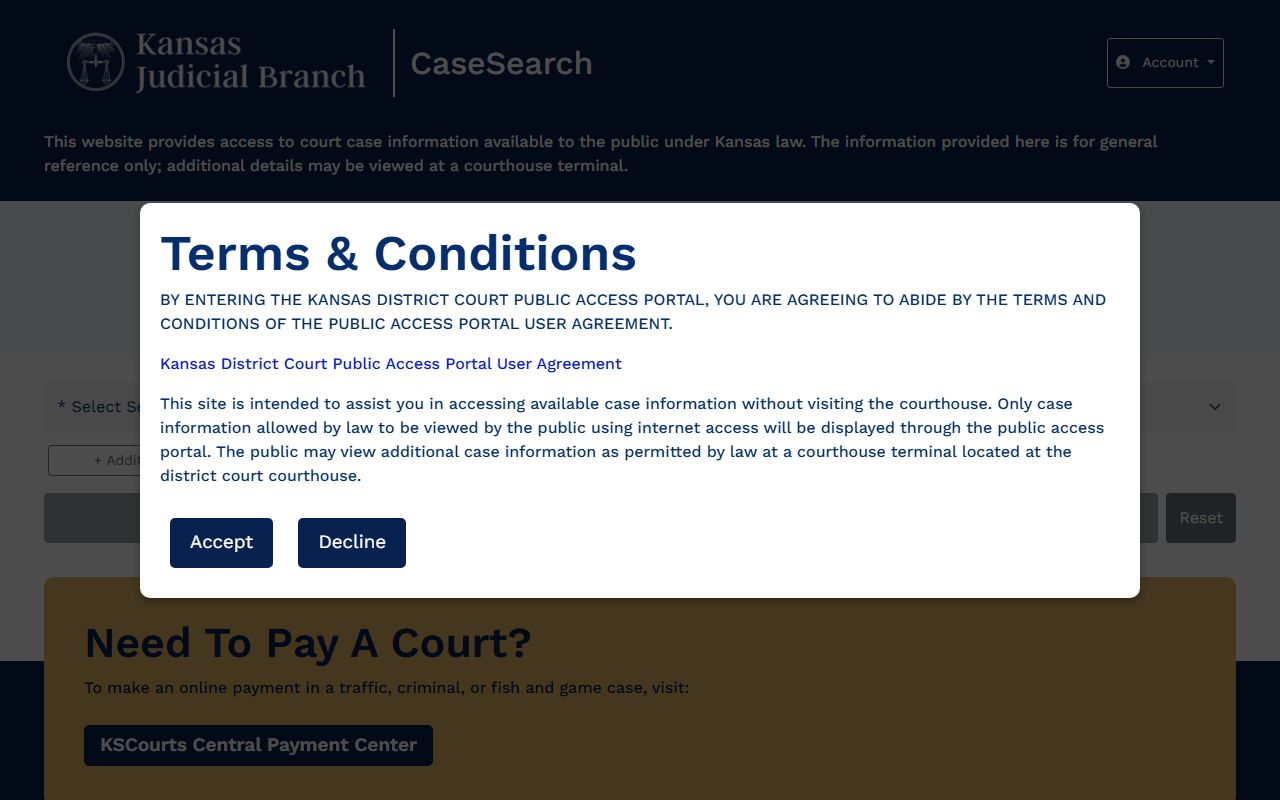
Use the portal for filed case data, but use the jail for live custody and release information.
For in-person access, Morton County District Court is at 1025 Morton Street in Elkhart, with public hours listed as Monday-Friday, 8 a.m. to noon and 1 p.m. to 5 p.m. Court copy procedures, courthouse terminals, and older files should be confirmed with the clerk. For jail-side records that are not court filings, ask the sheriff's office how to make a KORA request and ask for the statutory basis if a record is withheld.
Morton County Court Search Fields
The research identified visible Kansas CaseSearch field types rather than a county-only court portal. The fields can help narrow court records after a Morton County arrest, but access and available criteria may depend on portal terms and the user's role. For a precise file, a court case number is best. For most public lookups, the defendant's name is the likely starting point.
| Field Label | Type | Required | Notes |
|---|---|---|---|
| Case number | Text | Optional or role dependent | Best when the exact court case number is known. |
| Party name | Text | Optional | Use defendant or person party names for criminal case searches. |
| Business name | Text | Optional | Applies to business or entity parties. |
| Citation | Text | Optional | Useful for traffic or citation-related matters. |
| Other role criteria | Varies | Role dependent | The portal states that other criteria are available based on the user's role. |
Charges After Morton County Arrest
Booking allegations are early law-enforcement entries. They can change once the prosecutor reviews reports, witness statements, probable cause, prior case history, and available evidence. A complaint, information, or indictment is the document that turns an arrest into a filed court case. Morton County court records after an arrest should therefore be read by charge status, not just by the first booking label.
| Complaint | Information | Indictment | |
|---|---|---|---|
| Filed By | Officer or prosecutor | Prosecutor | Grand jury |
| Common For | Initial criminal cases and many misdemeanors | Many felony prosecutions | Serious cases where grand jury action is used |
| Starts | A filed court case | A filed court case | A filed court case |
| Why It Matters | Shows the accused offense as filed | May replace or refine earlier charges | Reflects grand jury charging action |
Morton County Charge Status Records
Charges can be pending, amended, reduced, dismissed, or resolved by plea, trial, diversion, or another court order. A jail record may show the arrest basis, while the court record shows what the prosecutor filed and what the judge later ordered. Read each count separately. One count can be dismissed while another remains active.
| Status | What It Means |
|---|---|
| Pending | The charge remains active and has not reached final disposition. |
| Amended or reduced | The charge was changed, often after review, negotiation, or new information. |
| Dismissed | The court record shows that the charge was ended by court action. |
| Nolle prosequi | A prosecutor declines to proceed on the charge, where that entry appears in the case record. |
| Convicted | The charge resulted in a guilty plea, verdict, or other conviction entry. |
Bond After Morton County Arrest
Bond and release questions sit between jail records and court records. K.S.A. 22-2802 governs release prior to trial, including appearance bonds, cash bonds, and personal recognizance. Jail staff can usually say whether a bond amount or hold appears in the custody record, but the court controls formal release orders and changes. If a defendant has not yet appeared before a judge, bond may still be pending.
| Bond Type | How It Works |
|---|---|
| Cash bond | Money is posted directly to satisfy the court's required amount. |
| Surety bond | A bail agent posts surety under Kansas commercial bail practice. |
| Personal recognizance | Release is based on a promise to appear and obey conditions, without a cash deposit. |
| No-bond hold | Release is not available until the court changes the order or the holding agency clears it. |
| Outside detainer | Another agency asks the jail to hold the person for transfer, warrant, parole, federal, or immigration reasons. |
Warrants and Court Records
No official Morton County online active warrant list, sheriff warrant search form, most-wanted list, or mobile app warrant feed was found in official sources. A warrant check should use direct channels: the sheriff's office for law-enforcement questions and Morton County District Court for bench warrants tied to filed cases. K.S.A. 22-2401 states that an officer may arrest a person with a warrant or when probable cause exists to believe a felony warrant has been issued in Kansas or another jurisdiction.
Types of warrants differ. An arrest warrant commands law enforcement to arrest. A bench warrant often follows failure to appear or failure to comply with a court order. A search warrant authorizes a search and is not a jail roster item. A fugitive or outside warrant may lead to a hold for another jurisdiction. Jail staff cannot give legal advice about how to resolve a warrant.
Charges Versus Convictions
An arrest and a filed charge are not the same as a conviction. Morton County court records after a jail arrest may show accusations that are later changed or dismissed. A conviction requires a guilty plea, verdict, or other final finding. This distinction matters for employment screening, licensing, housing, and personal record review, especially because this resource is not a consumer reporting agency.
| Charge | Conviction | |
|---|---|---|
| Stage | Accusation filed in court | Final finding, plea, or verdict |
| Proof Level | Based on charging standards and probable cause | Requires proof beyond a reasonable doubt or a valid plea |
| Record Meaning | Shows what was alleged | Shows the final criminal outcome for that count |
Sealed and Expunged Arrest Records
K.S.A. 22-2410 allows a person arrested in Kansas to petition for expungement of an arrest record when the legal requirements are met. Expungement is a court process, not a phone request to the jail. Juvenile detention records, criminal investigation records, medical records, security details, and some dismissed or sealed case material may also be restricted under Kansas law.
| Sealed | Expunged | |
|---|---|---|
| Visibility | Hidden from ordinary public view by court rule or order. | Limited by an expungement order after a successful petition. |
| Law Enforcement | May retain limited access where law allows. | May retain access for specific legal purposes. |
| How It Happens | By statute, court rule, or court order. | By petition and court order under Kansas law. |
Kansas Criminal History Checks
A court docket is not the same as a complete statewide criminal history. Kansas provides a separate Kansas criminal history record search, and the research notes a $30 fee for a name-based record check. That search is different from CaseSearch, different from the Morton County jail record, and different from KDOC KASPER. Use the right system for the right question.
Important: Do not use casual jail, court, or locator searches for credit, employment, insurance, tenant screening, or any FCRA-covered decision.
Restricted Morton County Court Records
Kansas open-records law starts with a public-access baseline, but not every arrest-related record is open. K.S.A. 45-216 states the public policy of access. K.S.A. 45-218 covers inspection requests, responses, refusals, and fees. K.S.A. 45-221 lists records not required to be disclosed, including exceptions used for criminal investigation material. K.S.A. 38-2332 limits juvenile detention in jail except as allowed by statute. If a court, jail, or sheriff's office withholds a record, ask for the statutory basis and whether any public portion can be released.